Pre-validated policy templates for regulated industries. Each configuration maps directly to compliance framework requirements and deploys without code changes.
Finance
Enforce data-loss prevention on financial content, attach mandatory disclaimers to all AI-generated output. Configurations mapped to FINRA, SEC, and MiFID II control requirements.
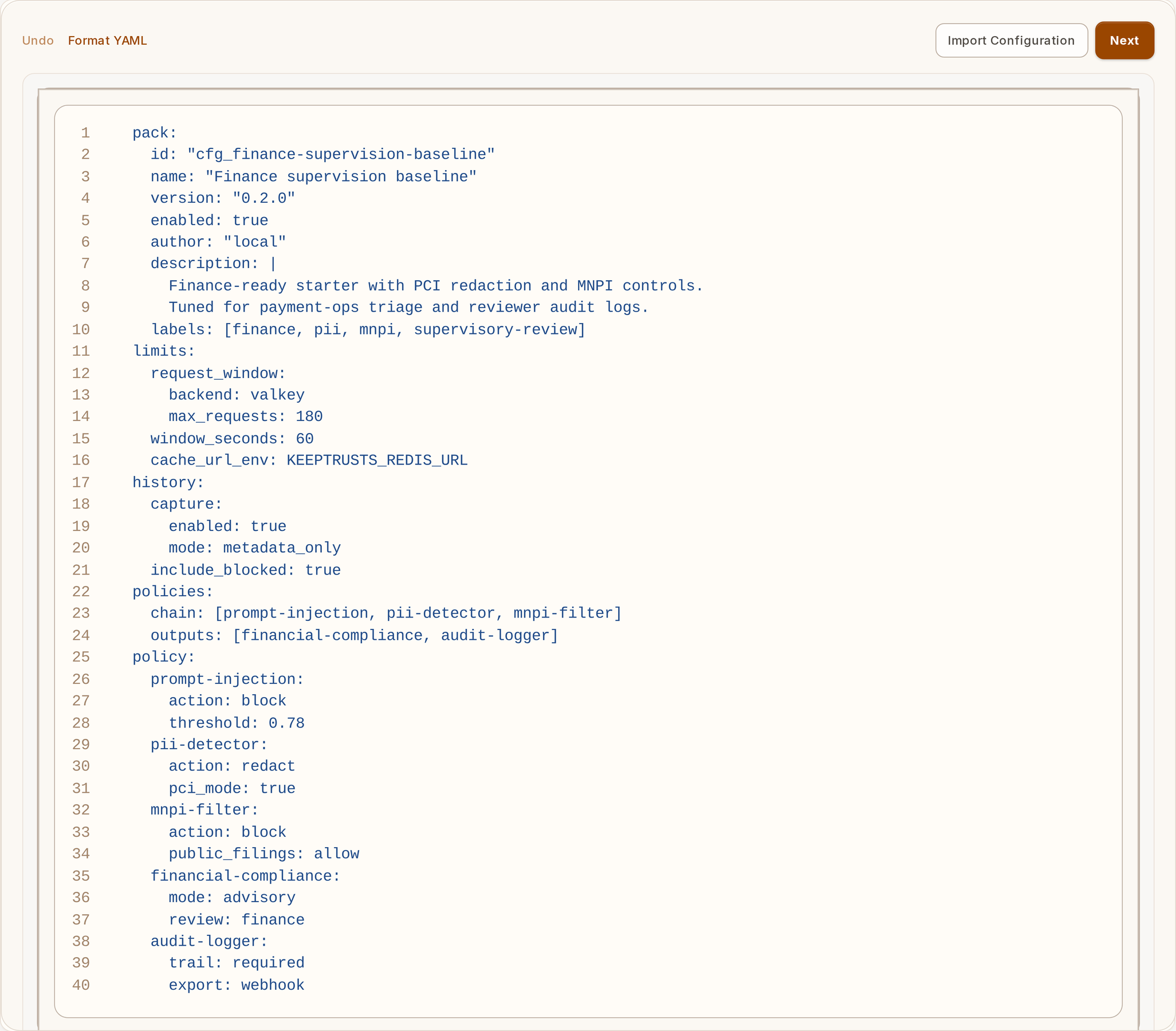
policies:
chain: ["dlp-filter", "financial-compliance"]
policy:
dlp-filter:
blocked_terms: ["insider trading", "earnings before announcement"]
action: block
financial-compliance:
required_disclaimers: ["not financial advice"] Keeptrusts provides tools and templates that support compliance efforts. Use of Keeptrusts does not guarantee regulatory compliance. Consult qualified legal counsel for your specific requirements.
Every request traverses the policy enforcement layer before reaching any model. The gateway redacts PII, verifies access controls, and writes an immutable audit record on each transaction.
Data Protection
PII redaction, data minimization, and erasure workflows execute inline within the request pipeline at the enforcement layer.
GDPRAudit & Retention
Every prompt and response produces a timestamped, immutable log entry. Retention windows and long-term export are configurable per policy.
Immutable LogsAccess Governance
Team-scoped permissions, role-based access control, and human-in-the-loop escalation gates for high-risk request classifications.
RBACRegulatory Templates
Production-validated configurations for HIPAA, GDPR, EU AI Act, FINRA, and additional frameworks. Deploy-ready with documented control mappings.
Encryption & Isolation
AES-GCM-SIV encryption at rest, TLS 1.3 in transit, and full air-gapped deployment capability. Data residency remains within your network boundary.
AES-256Gateway
Policy enforcement proxy supporting 50+ AI providers. Executes routing logic, applies the policy chain, and writes audit records per transaction. 1–5 ms overhead. Deploys cloud, on-premises, or air-gapped.
- Multi-provider routing with ordered failover
- Inline policy chain enforcement
- Immutable request/response audit trail
- 1–5 ms per-request processing overhead
The gateway routes each request to the optimal provider based on task classification, latency requirements, and cost constraints — without application-level changes.
Claude 4 Sonnet
Anthropic
Optimized for long-form content generation with precise tone control, strong narrative coherence, and high natural-language output quality.
Illustrative examples — actual routing is determined by your policy configuration and routing rules.
What is Keeptrusts?
Keeptrusts is the AI operations infrastructure layer for organizations. It operates between applications and AI providers to execute routing logic, enforce policy chains, and maintain a complete, queryable audit trail. It is not a model or provider — it is the governance and observability layer for AI traffic.
Why do teams add Keeptrusts?
Teams adopt Keeptrusts when AI integrations lack centralized routing, policy enforcement, spend governance, and audit continuity. Without a shared infrastructure layer, each application builds its own governance logic independently — producing inconsistent controls and duplicated engineering effort.
Does Keeptrusts work with major AI providers?
Yes. Keeptrusts supports 50+ hosted and self-managed providers, including OpenAI (GPT-4, GPT-4o, o1, o3), Anthropic (Claude), Azure OpenAI, AWS Bedrock, Google Gemini, Mistral, Cohere, GitHub Models, and local models served via Ollama or vLLM.
How quickly can Keeptrusts be deployed?
Initial traffic routing is operational within one business day. Deployment requires a single environment variable change — the AI provider base URL — with no SDK integration, application code modifications, or data migration.
How is Keeptrusts different from a regular API gateway?
A standard API gateway handles authentication and HTTP routing. Keeptrusts performs AI-semantic request inspection — reading prompt and response content to execute PII redaction, content classification, required disclaimer injection, and human-in-the-loop escalation. These enforcement actions are not achievable with a generic reverse proxy.
What happens to prompts and responses — does Keeptrusts store them?
By default, the gateway writes full request and response payloads to the audit store. Storage behavior is configurable: disable storage entirely, apply field-level masking before write, or set retention windows for automatic deletion. Air-gapped deployments ensure data remains within the network boundary.
Does Keeptrusts add latency?
The gateway is a compiled Rust binary with a low-overhead policy evaluation path. Measured per-request overhead is 1–5 ms, varying with policy chain complexity.
Does Keeptrusts support HIPAA, GDPR, and the EU AI Act?
Keeptrusts includes policy templates aligned with HIPAA (PHI redaction, audit trails), GDPR (data minimization, deletion workflows, cross-border routing restrictions), the EU AI Act (human oversight, risk classification logging, Article 13 transparency), and financial-services frameworks such as FINRA and SEC. These templates support compliance efforts but do not guarantee regulatory compliance on their own.
Does Keeptrusts work with local or self-hosted models?
Yes. Any model served through an OpenAI-compatible HTTP endpoint — including Ollama, vLLM, llama.cpp server, and LM Studio — works with Keeptrusts. The gateway treats them the same way as hosted providers.
What AI governance policies can Keeptrusts enforce?
Keeptrusts can enforce policies such as input and output PII and secret redaction, content classification and blocking, provider and model routing with failover, spend limits per team or use case, required disclaimers on AI-generated content, escalation to human review, prompt injection detection, data-sovereignty routing, and output-format normalization.
Production AI requires production governance.
Single gateway. Multi-provider routing. Full audit coverage. Deploy Keeptrusts in your environment.